
Your habits don't fail
because of
motivation.
Behavioral science has known for decades exactly why habits fail — and it has nothing to do with discipline. It comes down to which stage of your Habit Cycle goes unaddressed.
HabitRx is built around the Habit Cycle from The Science of Habits — for doomscrolling, procrastination, nail biting, and the habit you name — with a way back the day after you fall off.
Find Out Why Your Habit SticksFree Habit Cycle Score · 3 minutes · See which stage keeps your habit going
What the research shows
of New Year's resolvers were still keeping their resolution after 2 years
Norcross & Vangarelli (1988)
true average for habit automaticity — not the popular "21 days"
Lally et al., UCL (2010)
exercised in the following week after making an if-then plan, vs. 38% without one
Milne, Orbell & Sheeran (2002)
in one review link if-then plans to better follow-through on goals (average effect d = 0.65)
Gollwitzer & Sheeran (2006)
The Real Problem
Why most habit systems fail
For busy professionals who know what to do — but can't figure out why they keep not doing it.
Most programs target the wrong stage
Habit systems focus on the Action — the behavior itself. But habits are built and broken at the Trigger and Craving stages. Fixing what you do without addressing what activates you is why relapse rates are so high.
Willpower is unreliable when you need it most
Stress, tiredness, and busy days are exactly when old habits show up, and they are also when self-control feels hardest to use. Research on whether willpower simply "runs out" is mixed. A plan that does not depend on daily discipline holds up better on hard days.
Stress brings the old habit back
On a stressful or tiring day, you fall back on whatever is most automatic. If the old habit is still the easiest option, it wins, no matter how motivated you were last week. HabitRx builds the system around you: more friction between you and the habit you want to drop, less friction toward the one you want, and a plan for getting back on track after a slip.

The Solution
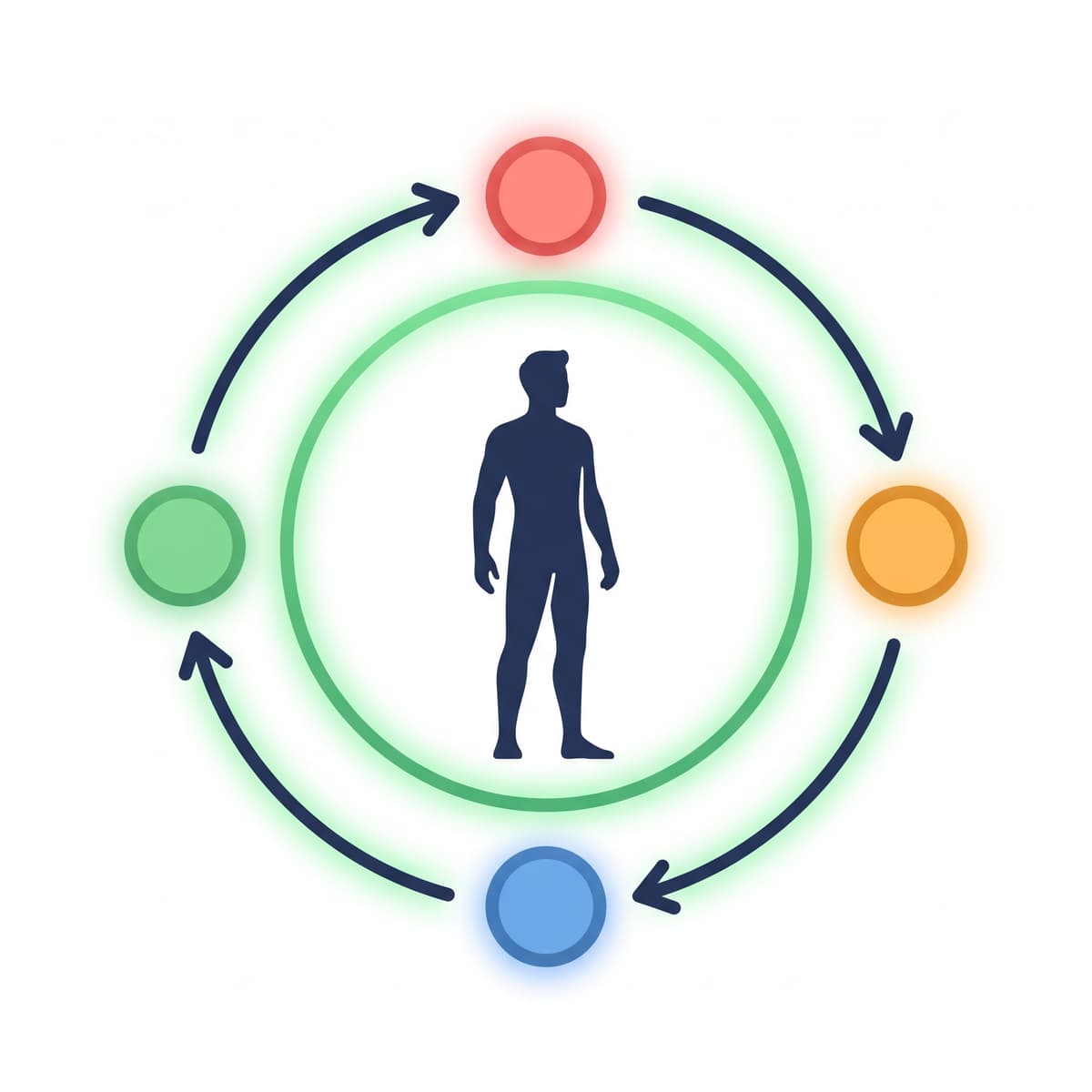
Every habit runs on the same cycle.
Procrastination, doomscrolling, stress eating, poor sleep — all governed by four stages. HabitRx builds your protocol around every one of them.
Hover each stage to learn more
Habit Cycle framework from The Science of Habits
by Dr. Adarsh K. Gupta · © HabitRx
The cue that fires your habit — a time, place, emotion, or person that activates the cycle automatically.
Stress at 3pm → reach for sugar
The urge generated in response to the trigger — the motivational state that creates the pull to act.
The need for relief or stimulation
The habitual behavior your nervous system executes automatically — often before conscious thought.
Eating, scrolling, procrastinating
The relief or pleasure that reinforces the cycle — making it stronger with every repetition.
Temporary relief → craving returns stronger
See It In Action
What habit do you want to change?
Select one to see how HabitRx rewrites the cycle.
The Shift
Life before your TCAR protocol. Life after.
The same person. A different system. A completely different relationship with their habits.
Before HabitRx
"I keep starting over every month."
"I know what to do — I just don't do it."
"I miss one day and quit completely."
"No app has ever addressed WHY I fail."
"Nothing sticks longer than 3 weeks."
After Your TCAR Protocol
You recover automatically after missing two days.
Your triggers are mapped — you see them before they fire.
You have a 30-day calendar with daily actions, not just intentions.
Your craving has a named strategy, not just willpower.
You become the kind of person who never has to start over.
The Physician Behind HabitRx
Dr. Adarsh K. Gupta, DO, MS
Habit Scientist & Author · Cochrane Associate Editor
HabitRx applies the Habit Cycle from The Science of Habits. The book draws on decades of studying how everyday habits form and how a person can practice changing them.
TCAR — Trigger, Craving, Action, Reward — is the framework of that book, grounded in published behavioral science. HabitRx is educational. It is not medical advice.
Start With the $79 Custom Plan →What's Included
Everything in your $79 Custom Plan
Delivered to your inbox within minutes. No app install required.
A 30-day practice run. In one study, the median time to automaticity was 66 days (Lally et al., 2010), with a range of 18 to 254 days. The calendar is the start, not a finished habit.
Personalized TCAR Protocol
Your exact Trigger identified, Craving strategy mapped, Action redesigned, Reward chosen — plus ready-to-use if-then plans and a habit stack built from your own routine.
30-Day Implementation Calendar
28 daily micro-actions calibrated to your timeline, lifestyle, and past failure patterns — not a generic plan.
The Science of Your Habit
A plain-language guide to the behavioral science behind your specific habit — why it fires, what drives it, and what the research says about changing it.
TCAR Habit Cycle Worksheet
A structured fillable document mapping your personal Trigger, Craving, Action, and Reward — your working companion for 30 days.
Curated Workbook Recommendation
One physician-selected resource matched to your weakest Habit Cycle stage, with an explanation of why it fits your specific pattern.
The Process
Three steps. One protocol. Lasting change.
Answer 8 Questions
Tell us your habit, when it fires, what you've tried, and your goal. Takes under 3 minutes.
Your Protocol, Personalized
Dr. Gupta's TCAR framework is applied to your specific responses. AI-assisted personalization, physician-designed methodology.
Execute Your 30-Day Calendar
Follow daily micro-actions designed to interrupt your Habit Cycle and install the replacement behavior.
Frequently asked questions
What is HabitRx?+
HabitRx is a physician-designed habit change program built on the TCAR Habit Cycle (Trigger, Craving, Action, Reward) from Dr. Adarsh K. Gupta’s book The Science of Habits. It includes a free Habit Cycle Score quiz, a $79 personalized 30-day plan, and printable workbooks for each stage of the cycle.
How long does it take to break a habit?+
Longer than the popular “21 days.” In a study of 96 people forming new daily habits, it took a median of 66 days for a behavior to become automatic, with a range of 18 to 254 days depending on the person and the behavior (Lally et al., 2010). A 30-day plan is a strong start, not a finish line — keep going past day 30.
How is TCAR different from Atomic Habits?+
James Clear’s model in Atomic Habits also has four stages (cue, craving, response, reward), so the two agree on how habits work. TCAR differs in how you use it: the free Habit Cycle Score measures which stage is weakest for you, and each stage is paired with a specific research-backed technique — trigger mapping, urge surfing, if-then planning, and reward design — instead of general rules applied to every habit.
What is the Habit Cycle Score?+
A free, 3-minute quiz that scores each of the four stages of your Habit Cycle — Trigger, Craving, Action, and Reward — and shows which one is costing you the most, so you know where to focus first.
Is HabitRx medical advice?+
No. HabitRx is behavioral education, not medical advice, diagnosis, or treatment, and using it does not create a doctor–patient relationship. If you have a medical or mental health condition, or are working on alcohol or substance use, talk to your own clinician.
Stop starting over.
Start recovering.
The physician-designed behavioral system for people who are ready to stop starting over — and start executing consistently.
Get My Custom TCAR Plan — $79Answer 8 questions · Delivered in minutes
Educational content only. Not medical advice, diagnosis, or treatment. Results vary. © 2026 HabitRx.