The most reliable way to break bad habits is to work on the four stages every habit passes through: the Trigger, the Craving, the Action, and the Reward. When you change what happens at each stage, the old routine loses its grip and a new one has room to grow. A good plan for the moments that matter will carry you further than willpower.
How to break bad habits by working through the Habit Cycle
Every habit, good or bad, runs on the same four-step Habit Cycle:
- Trigger: a cue that starts the sequence. It might be a place, a time of day, a person, or a feeling like boredom or stress.
- Craving: the pull you feel toward a certain result. You want the relief, the distraction, or the small hit of pleasure.
- Action: the behavior itself, such as picking up your phone, biting your nails, or opening a bag of chips.
- Reward: the payoff. It satisfies the craving and teaches your brain to repeat the sequence next time the trigger shows up.
Researchers who study habits describe them as actions that get linked to the setting where they happen [1]. After enough repeats, the setting alone can set off the behavior, often before you have made a conscious choice. That is why "just stop" so rarely works. By the time you notice, the cycle is already running.
The good news is that each stage gives you a place to step in. If you want to break bad habits for good, plan something for all four. You can see a fuller walk-through of the model on the TCAR Method page.
Stage 1: Find and fence off your triggers
You cannot interrupt a cue you have never noticed. For one week, each time you catch yourself in the habit, jot down a few quick notes:
- When did it happen?
- Where were you?
- What were you doing right before?
- How did you feel?
- Who was around?
Most people see a pattern within a few days. Snacking out of boredom might cluster around 3 p.m. at your desk. Nail biting might show up during video calls. Phone checking might spike the moment you sit on the couch after dinner.
Once you know your triggers, you can remove the cue, such as charging your phone in the kitchen instead of by the bed. Or you can run into it less often, like closing email tabs while you work on a big task. When the cue is gone, the cycle has nothing to start it.
Stage 2: Ride out the craving
Some triggers cannot be avoided. Stress, tiredness, and boredom will show up no matter how well you design your space. When they do, the craving arrives, and that is the moment most people give in.
A technique called urge surfing can help. Urge surfing means noticing the urge, naming it, and watching it like a wave instead of acting on it right away. Researchers including the late Alan Marlatt taught versions of this skill, and in one study a short lesson in it changed how participants responded to their urges [4]. The core idea is simple: many urges rise, peak, and fade within minutes if you do not feed them.
To try it:
- Pause and say to yourself, "I'm having an urge to check my phone."
- Notice where you feel it. Restless hands? Tight chest? A busy mind?
- Take a few slow breaths and stay curious about it.
- Wait a few minutes before you decide what to do.
You are not trying to win a fight. You are giving the craving time to pass so your next choice is a real choice.
Stage 3: Swap the action and add friction
If you remove an old action without putting something in its place, the trigger and craving still fire with nowhere to go. Sooner or later, the old routine fills the gap. So the goal at this stage is to swap in something new.
Pick a replacement that fits the craving
Ask what the habit actually gives you. Then pick a new action that delivers something similar:
- If boredom sends you to social media, the craving may be for novelty. Try a short puzzle, a page of a book, or a quick message to a friend.
- If restlessness leads to nail biting, the craving may be for something to do with your hands. Keep a stress ball or a pen nearby.
- If stress pulls you toward the snack drawer, the craving may be for a break. Try a five-minute walk or a glass of water by the window.
Use if-then plans
An if-then plan links a specific situation to a specific response: "If X happens, then I will do Y." Psychologists call these implementation intentions. A large review of 94 studies found that people who made if-then plans reached their goals more often than people who only set the goal, with an average effect size of 0.65, which researchers consider a medium-to-large effect [3].
The plan works because it makes the decision ahead of time. When the trigger shows up, you already know your move.
Make the old action harder
Friction is any extra step between you and the behavior. A little friction goes a long way:
- Log out of apps after each use.
- Move tempting apps off your home screen.
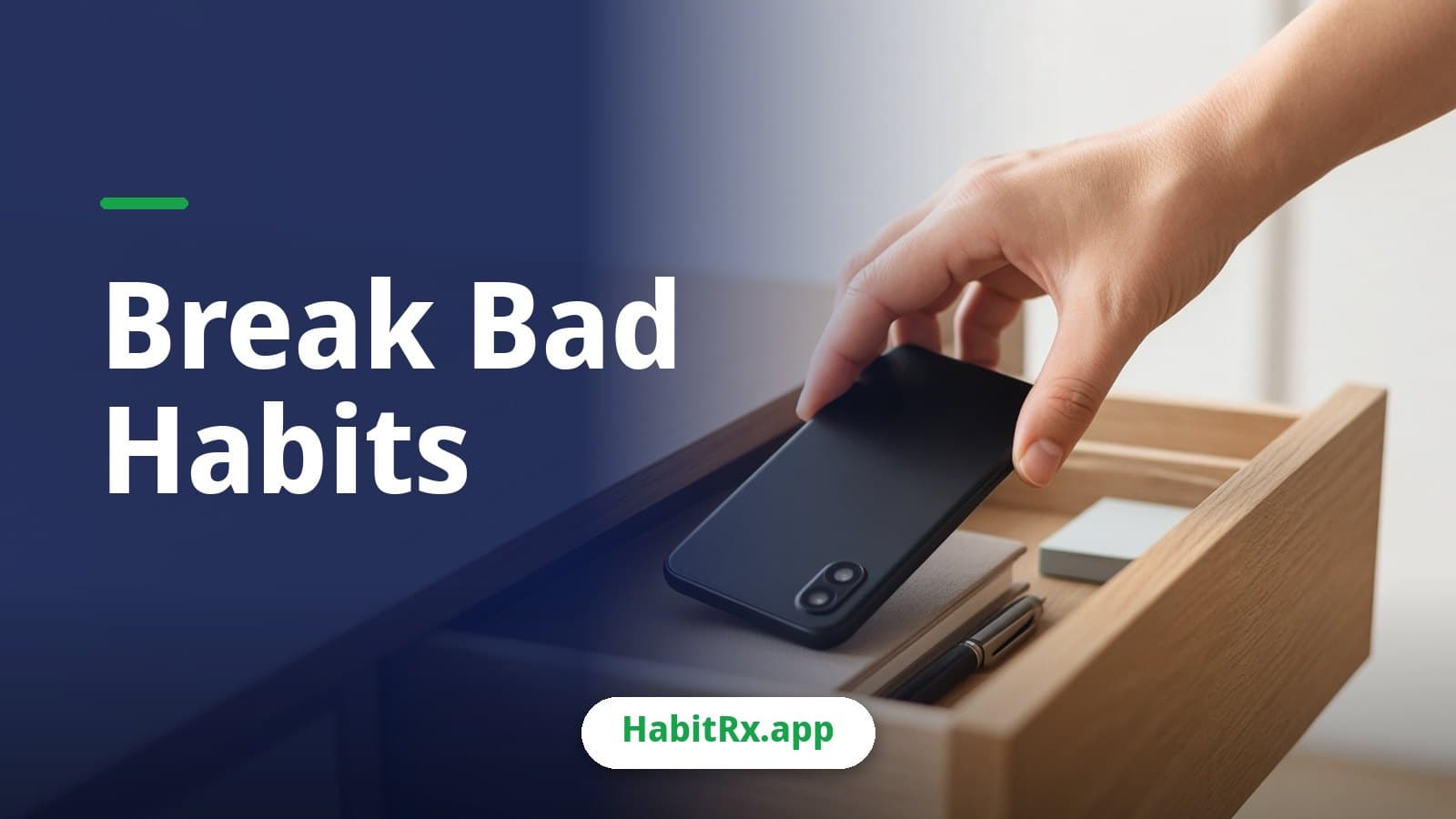
- Keep the phone in a drawer during focused work.
Stage 4: Give the new routine a reward
The Reward stage is what teaches your brain to repeat a behavior. Old habits often pay off right away. New ones may take weeks to feel good on their own. That gap is a big reason people drift back.
You can close the gap by adding a small, immediate reward. One approach is temptation bundling, which means pairing something you enjoy with something you are trying to build. In one study, people who could only listen to gripping audiobooks while at the gym went to the gym more often, at least at first [5]. You might save your favorite podcast for your evening walk, or enjoy a good coffee only once your first focused work block is done.
Tracking is a reward too. A meta-analysis found that monitoring progress toward a goal tended to help people reach it, especially when the progress was written down or shared [6]. A simple calendar with an X for each day you stuck with the plan can feel surprisingly satisfying.
A worked example: late-night phone checking
Let's put the four stages together. Say you keep scrolling in bed for an hour and wake up groggy.
- Trigger: Lying in bed with the phone on the nightstand.
- Craving: Wanting to unwind and feel connected after a long day.
- Action: Opening social media "for just a minute."
- Reward: A stream of new posts and a break from your own thoughts.
Here is a stage-by-stage plan:
- Trigger: Charge the phone in the kitchen. Use a cheap alarm clock instead.
- Craving: When you feel the pull, name it and take five slow breaths.
- Action: Write the if-then plan: "If I get into bed and want my phone, then I will read two pages of a paper book."
- Reward: Keep a book you actually enjoy on the nightstand, and mark each phone-free night on a calendar.
None of these steps needs heroic effort, yet together they change every point in the cycle.
How long it takes, and what to do when you slip
You may have heard that a habit takes 21 days. The research tells a messier story. In one study, people building a new daily habit took anywhere from 18 to 254 days before it felt automatic, with a middle value of about 66 days [2]. Simpler habits tended to settle in faster than harder ones.
The same study found that missing a single day did not have a large effect on long-term progress. That matters. A slip does not erase your work. When it happens:
- Notice which trigger caught you off guard.
- Adjust one part of your plan.
- Get back to the routine at the very next chance.
If a habit feels severe or is causing you real distress, it is worth talking with a qualified professional.
Use the same stages to build good habits
The tools that help you break bad habits also help you build good ones. You just run them in reverse.
- Trigger: Attach the new habit to something you already do. "After I pour my morning coffee, I will write my top task for the day."
- Craving: Make the habit appealing. Pair it with music, a nice notebook, or a favorite spot.
- Action: Start smaller than feels necessary. One page, two minutes, five push-ups. Make it easy to begin.
- Reward: Notice and enjoy the small win right away, and track it.
Once a small routine runs on its own, you can grow it. Small steps are also how most people break bad habits that have lasted for years.
If you want to know which stage of your own Habit Cycle is the weakest link, take the free Habit Cycle Score. It points you to where your effort will pay off most. And for a deeper look at why we do what we do, and how to change it, see The Science of Habits. When you work on all four stages, you give yourself the best chance to break bad habits and keep the new ones you choose.