Motivation fades because it is a feeling, and feelings rise and fall with your sleep, your stress, and the kind of day you are having. What keeps a habit going is a setup that still works on a flat, tired Tuesday: a clear trigger, an action small enough to do when you are worn out, and a reward you notice right away. Repeat that in the same situation, and over time the behavior needs less push from you.
Why motivation fades after the first week
Think about the last time you started something new. Day one felt great. You bought the notebook, cleared a shelf, or set an early alarm. By day six, the same task felt like a chore. By day ten, you were skipping it and wondering what happened.
That pattern is very common, and the causes are fairly simple. Here is why motivation fades for most people:
- Novelty wears off. A new plan feels exciting because it is new. The brain's anticipation signal is strongest when you imagine a reward, and the tenth repetition of anything feels less thrilling than the first.
- Your state changes. Motivation depends on energy, mood, and free time. One bad night of sleep or one hard meeting can drain it in an hour.
- The payoff is far away. Many goals pay off in months. The effort shows up today. When the reward is distant, today's effort feels expensive.
- Planning feels like progress. Making a plan gives you a small lift. That lift can trick you into feeling like you already did something.
None of this means you lack discipline. It means the habit was running on fuel that was always going to run low.
What motivation is actually good for
Motivation is still useful. It gets you to start, helps you decide what matters, and gives you the energy to set things up. The trouble comes when you also ask it to handle the daily repetition, week after week, through busy seasons and bad moods.
Here is a helpful picture: motivation is the match, and the habit is the fire. You need the match to get things going. After that, you want the fire to keep burning on its own fuel, which is your environment and your routine.
So use your high-motivation days well. Spend some of that energy building the system around the task:
- Put your walking shoes by the front door.
- Move the distracting app off your home screen.
- Set out tomorrow's journal and pen tonight.
- Write down your if-then plans (more on these below).
Those choices keep working long after the excited feeling is gone.
What keeps a habit going when motivation drops
Researchers who study habits have found that much of what we do each day is tied to context. Context means the place, the time of day, the people around you, and whatever you just finished doing. In a well-known review, psychologists Wendy Wood and David Neal described habits as responses that get set off by these cues, often with little thought about your goals [1]. Once a habit forms, the situation does a lot of the starting for you.
That is good news. You cannot control how motivated you will feel next Thursday. You can control what sits on your desk, what you do right after your morning coffee, and where your phone sleeps at night.
Repetition is the other half. In one study from University College London, volunteers picked a daily behavior, such as eating a piece of fruit with lunch or going for a short walk, and rated how automatic it felt over 12 weeks [2]. On average, it took about 66 days to reach a plateau of automaticity. The range was wide, from 18 to 254 days, and simpler behaviors tended to get there sooner.
Two takeaways from that study:
- Expect weeks, not days. If something still takes effort on day 20, you are right on schedule.
- The "this is easy now" feeling comes from repeating the behavior in the same setting. A burst of excitement cannot replace that.
Build the habit on the Habit Cycle
HabitRx uses the Habit Cycle to break any habit into four parts: Trigger, Craving, Action, and Reward. Understanding why motivation fades is useful, but the fix usually lives in one of these four parts. When you feel stuck, look for the weak link instead of trying to feel inspired again.
Trigger: make the cue specific
A vague intention like "I'll read more" has no clear starting point. A trigger is a cue you can see or feel, such as "after I pour my coffee" or "when I sit down on the train." Tie the new habit to something you already do every day, so the cue shows up whether you are in the mood or not.
Craving: give yourself a near-term reason
Craving is the pull toward the reward. Long-term goals are weak pulls. Make the reason closer and more concrete, such as "I get to hear the next episode of my favorite podcast." Researchers call one version of this temptation bundling, which means pairing a task you avoid with something you enjoy. In one study, people who could only listen to gripping audiobooks while at the gym went to the gym more often, at least in the early weeks, than people without that pairing [3].
Action: shrink it
Make the action small enough that you could do it on your worst day. Two minutes of stretching. One page. One email. You can always do more, but the smallest version is the one you promise yourself.
Reward: feel something right away
The brain learns from what happens right after an action. A reward can be tiny: checking a box, a sip of tea, saying "done" out loud, or noticing that you feel a little lighter. The goal is to close the cycle with something pleasant today, since a benefit six months away barely registers in the moment.
A worked example: the late-night phone scroll
Say you want to stop scrolling in bed and read instead. In week one, you are excited. You buy a novel and read for 30 minutes each night. By week two, you are tired, the phone is right there, and the book is collecting dust on the nightstand. This is exactly why motivation fades as a strategy: the plan depended on feeling eager at 10 p.m.
Here is how the Habit Cycle can rebuild it:
- Trigger: Turning off the bedroom light was the old cue for scrolling. Create a new, earlier cue. When you plug your phone into the kitchen charger at 9:45 p.m., you pick up the book.
- Craving: Focus on the near-term pull. Reading helps you wind down, and you want to know what happens in the next chapter.
- Action: Read one page. That is the whole commitment. Most nights, you will read more.
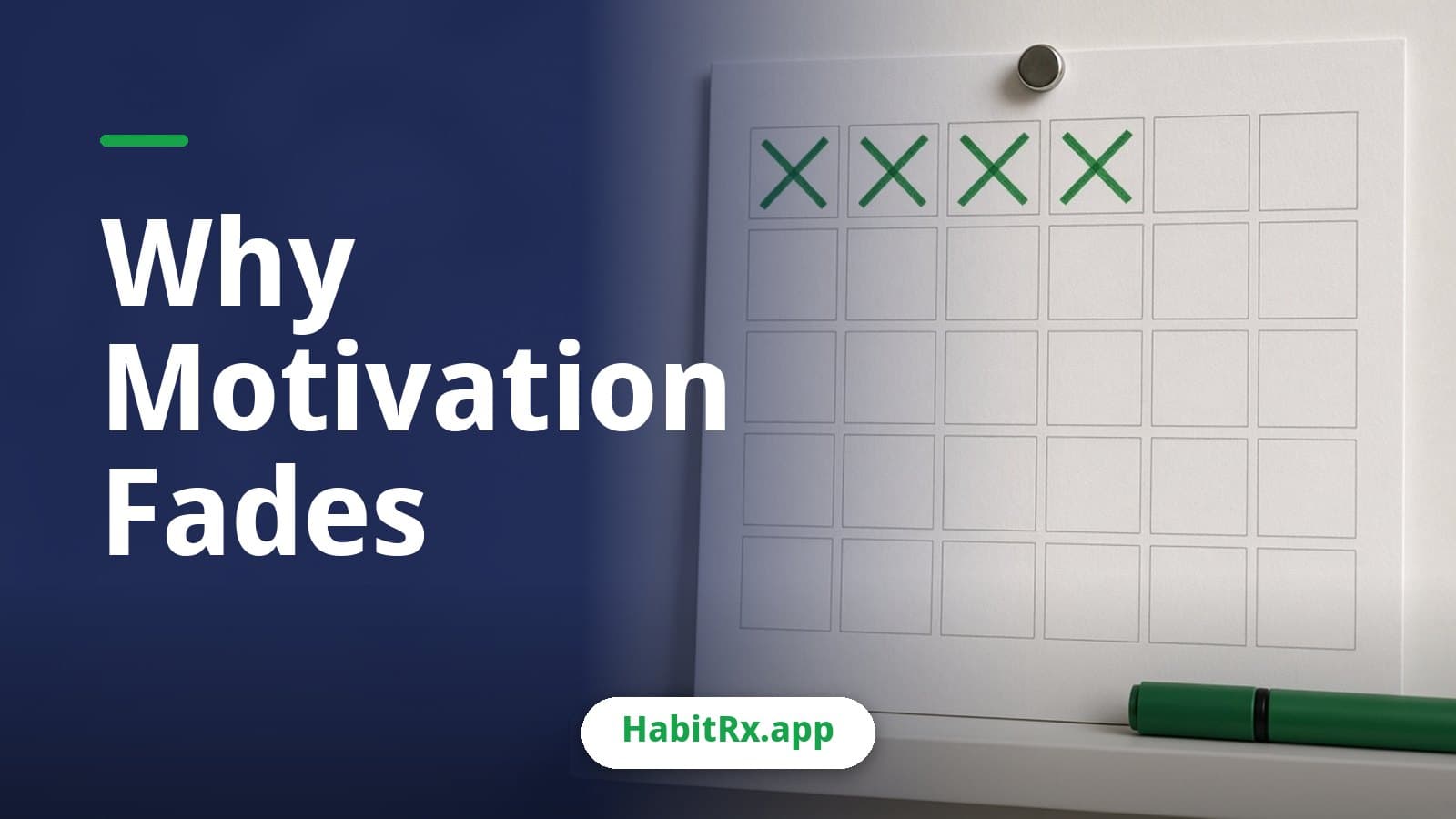
- Reward: Make a check mark on a sticky note inside the cover, and notice how much quieter your head feels without the feed.
Look at what changed. The phone is out of the bedroom, so the old trigger is gone. The new action is easy. Nothing in this plan requires you to feel motivated late at night.
Plan for the days you do not feel like it
Low days will come. The trick is to decide in advance what you will do when they arrive. Psychologist Peter Gollwitzer studied what he called implementation intentions, which is a formal name for simple if-then plans: "If situation X happens, then I will do Y" [4]. A large review of 94 studies found that people who made if-then plans reached their goals more often than people who only set goals, with a medium-to-large average effect [5].
Here are some if-then plans that help when motivation fades:
- "If I get home late and feel drained, then I will do the two-minute version."
- "If I skip a day, then I will start again at the very next trigger, without trying to make up for it."
- "If I reach for my phone during focus time, then I will put it in a drawer and take one slow breath."
Write two or three of these down and put them where you will see them. On a low day, you do not have to think or argue with yourself. You just follow the plan you made on a better day.
Why the habit gets easier with time
Each time you repeat the action after the same cue, the link between the two gets a little stronger. Over weeks, the cue starts to prompt the behavior with less effort. A review of habit research by Wood and Rünger describes this as a gradual shift from choices guided by goals to responses guided by cues [6].
That is the real answer to why motivation fades while a well-built habit keeps going. By the time the excited feeling is gone, the routine has started to carry itself. You still have to show up, but it stops feeling like a daily negotiation.
If you want to know which part of your Habit Cycle needs the most work, take the free Habit Cycle Score. It takes a few minutes and points you to the part worth fixing first. For a deeper look at how cues, cravings, actions, and rewards work together, Dr. Gupta's book The Science of Habits walks through the full framework with everyday examples. And if your routine keeps slipping even with a good plan, read about how to stay consistent next.