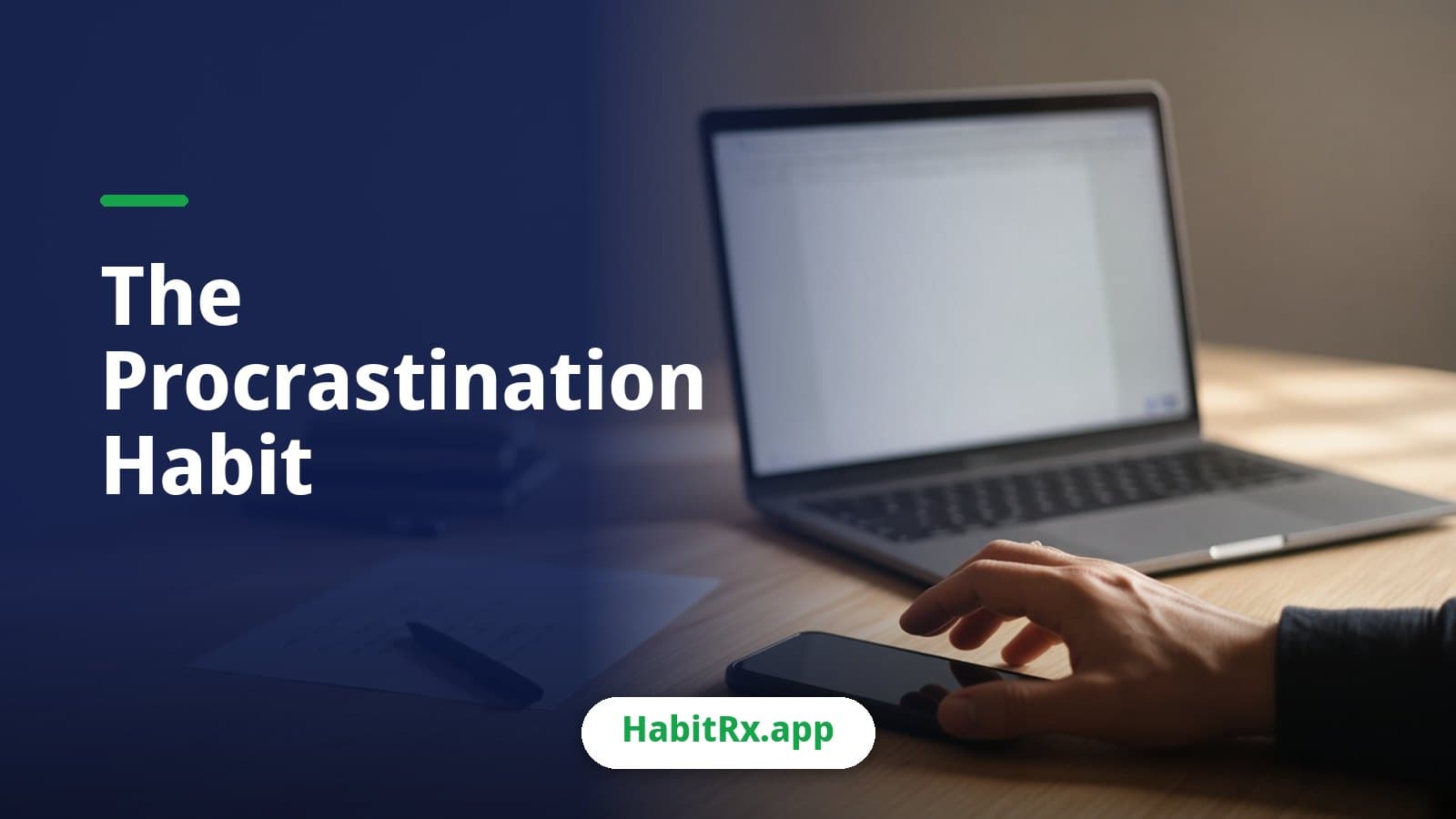
Procrastination is best understood as a learned habit. When a task makes you feel bored, anxious, or unsure, putting it off gives you quick relief, and your brain remembers that relief. The good news is that habits can be rebuilt, so you can change the pattern instead of fighting yourself every single day.
What the procrastination habit really is
Procrastination means choosing to delay something you meant to do, even though you expect the delay to cost you later. Almost everyone does it sometimes. It becomes a procrastination habit when the same delay shows up again and again, in the same kinds of moments, almost without you deciding.
A large review by Piers Steel pulled together results from many studies on procrastination. People tended to delay most when a task felt unpleasant, when the reward for finishing felt far away, and when they acted on impulse more easily [1]. Notice what is missing from that list. Laziness and a lack of caring are not the main drivers.
Psychologists Fuschia Sirois and Timothy Pychyl describe procrastination as "short-term mood repair" [2]. In plain words, you put a task off because doing so makes you feel better right now. The catch is that the relief is borrowed from your future self, who still has to do the task, often with less time and more stress.
People sometimes ask whether procrastination is an addiction. A more accurate and more useful way to see it is as a learned habit: a pattern your brain picked up because it paid off in the short term. Anything learned this way can be relearned.
How procrastination runs through the Habit Cycle
At HabitRx, we break every habit into four parts called the Habit Cycle: Trigger, Craving, Action, and Reward. Here is how putting things off fits that cycle.
- Trigger: Something cues the delay. It might be opening a blank document, seeing a vague to-do like "work on taxes," a certain time of day, or a feeling such as self-doubt.
- Craving: You feel a pull toward relief. This is the brain's anticipation signal, a quick prediction that something else will feel better than the hard task.
- Action: You reach for the escape. You check your phone, tidy the desk, answer easy emails, or watch "just one" video.
- Reward: The uncomfortable feeling fades for a while. That small burst of relief is what teaches your brain to repeat the cycle.
Researchers Wendy Wood and David Neal explain that habits become linked to the places and situations where they happen [3]. Once you have delayed a task at your desk at 7 p.m. enough times, the desk and the hour can start the cycle before you have made any choice at all. You can read more about the four parts in the TCAR Method.
Why "just try harder" rarely works
Most advice on procrastination boils down to "be more disciplined." That asks you to fight the craving at its strongest point, with nothing else changed. The trigger still shows up, and the escape still pays off.
There is a second problem. When you scold yourself for delaying, you add guilt and shame to the original bad feeling. More bad feelings give your brain even more reason to seek relief, so the procrastination habit can get stronger, not weaker. This is a big reason why a plan tends to beat pure effort, a theme we cover in willpower vs systems.
How to stop the procrastination habit, step by step
You do not need to change everything at once. Work on one task and one moment at a time.
Step 1: Name your trigger
For the next few days, jot down when you put something off. Write the time, place, task, and the feeling just before you looked away. Patterns show up fast. You may find that one type of task, like anything involving numbers, sets you off far more than others.
Step 2: Shrink the first action
A task like "write the report" feels huge, and huge tasks feed the craving to escape. Make the first step tiny and concrete:
- Open the file.
- Type the title.
- Write one rough sentence, even a bad one.
Starting is usually the hardest part. Once you are moving, keeping going often feels easier than expected.
Step 3: Write an if-then plan
An if-then plan, also called an implementation intention, links a specific situation to a specific action. For example: "If I sit down at my desk after dinner, then I will write three bullet points before I check my phone." A review of 94 studies found that people who made these plans reached their goals more often, with a medium-to-large average effect [4]. The plan works because the decision is already made when the trigger arrives.
Step 4: Give your brain a better reward
Your brain wants a payoff now, so give it one that does not involve escaping. One approach is called temptation bundling, which means pairing something you enjoy with the task you avoid. In one study, people who could only listen to gripping audiobooks while at the gym went more often, at least for a while [5]. You could save a favorite playlist or a special coffee for your hardest task.
Step 5: Change the setting
Since habits are tied to context, change the context [3]. Put your phone in another room. Close extra browser tabs. Work on the dreaded task in a new spot, like the kitchen table, where the old cycle has no history.
Step 6: Be kind after a slip
You will still delay sometimes. When you do, notice it without insult: "I put that off because it felt uncomfortable. What is the next small step?" A calmer reaction removes the extra bad feeling that keeps the procrastination habit going.
A worked example: the unfinished report
Maya has a monthly report due on Monday. Every Sunday evening she opens her laptop, sees the half-finished document, and feels a wave of doubt about whether her numbers are right. Within a minute her phone is in her hand. Forty minutes later the report is unchanged, and she feels worse.
Here is Maya's Habit Cycle:
- Trigger: Opening the report at 7 p.m. and seeing the blank sections.
- Craving: Wanting the doubt to go away.
- Action: Scrolling her phone.
- Reward: Brief relief, followed by guilt.
Maya builds a new plan. Her if-then plan reads: "If I open the report at 7 p.m., then I will fill in just the first table before I do anything else." Before she sits down, she leaves her phone charging in the hallway. She also makes the session pleasant by saving her favorite tea for report time only. Each time she finishes the first table, she puts a check mark on a sticky note by her screen.
After a few weeks, Maya notices that 7 p.m. on Sunday now cues "first table" instead of "phone." The doubt still shows up some nights, but it no longer runs the show.
How long it takes to change the pattern
Give the process time. In a study by Phillippa Lally and colleagues, people practiced a new daily behavior in the same setting. The time it took to feel automatic ranged from 18 to 254 days, with a median of about 66 days [6]. Missing a single day did not seem to undo their progress.
That means a rough week does not erase your work. What matters is returning to your plan, in the same setting, again and again.
If you want a clearer picture of where your own cycle tends to break down, try the free Habit Cycle Score. For a deeper guide to how habits form and how to rebuild them, Dr. Gupta's book The Science of Habits walks through the process in detail.
If putting things off is causing you serious distress or getting in the way of daily life, it is worth talking with a qualified professional.
The procrastination habit was learned one small moment of relief at a time, and it can be rebuilt the same way. Pick one task, name its trigger, and plan your first tiny step for the next time it shows up.